Using AI and Data Science to Fight Bias and Drive Opportunities
FICO’s expansion of its Educational Analytics Challenge and Responsible AI collaboration with customers globally can improve transparency and economic outcomes

As a data scientist, I’m always intrigued by the details of the artificial intelligence (AI) and machine learning (ML) innovation my team at FICO is constantly producing. As a student of life, I’m in awe of the impact AI innovation can have on society. And as an executive, I’m thrilled to be able to catalyze some of that impact and deploy meaningful change.
Two of my favorite endeavors of 2023 — FICO’s Educational Analytics Challenge designed for students at historically black colleges and universities (HBCU), and my Responsible AI collaboration with FICO customers and other organizations in Brazil, India and elsewhere — bring to life how Responsible AI is real, and how AI can drive positive and incredible change. In 2024 we’re expanding the FICO Analytics Challenge to include more schools, and I’m looking forward to exploring data science that can drive economic opportunities at profound individual and societal levels.
Why Diversity Matters in Data Science
We created the FICO Educational Analytics Challenge to help improve diversity in data science by jumpstarting more HBCU students’ involvement in the data science field. Access is key. The FICO Educational Analytics Challenge introduces students not just to core data science concepts, data sets and problem-solving; even more critical, it provides access to practitioner mentors. I very much enjoyed my conversations with students and faculty at Bowie State University and Alabama A&M University, and am proud of the FICO data scientists who have and will serve as mentors to these and upcoming student participants.
Last week we expanded the FICO Analytics Challenge to an additional HBCU, Delaware State University, where I received a warm welcome from faculty, students and staff – see here.
Why does diversity matter? In any field the stock answer is, “More and different voices lead to better solutions.” Let me double-click on that to explain how this broad answer plays out in data science.
Democratizing the field gets more students involved in data science problems that have historically affected them, such as bias in housing data, but in which their diverse voices were not heard. Providing transparency, exposure and guidance to these budding data scientists helps ensure that their voices are just not heard; they become part of the solution, advocating for change that benefits their communities and each other.
An Active Role in Stamping out Data Bias
In data science, different voices bring different perspectives. For example, I was impressed by how the Bowie State students were thinking about tract housing data. They pointed out that large amounts of tract housing on any given land parcel can be a proxy for race, and perhaps that data shouldn’t be used in an analytic loan originations model because it could impute bias. Other data scientists ultimately may have come to the same conclusion, but the eventual conversation would likely be missing that honest, passionate introspection.
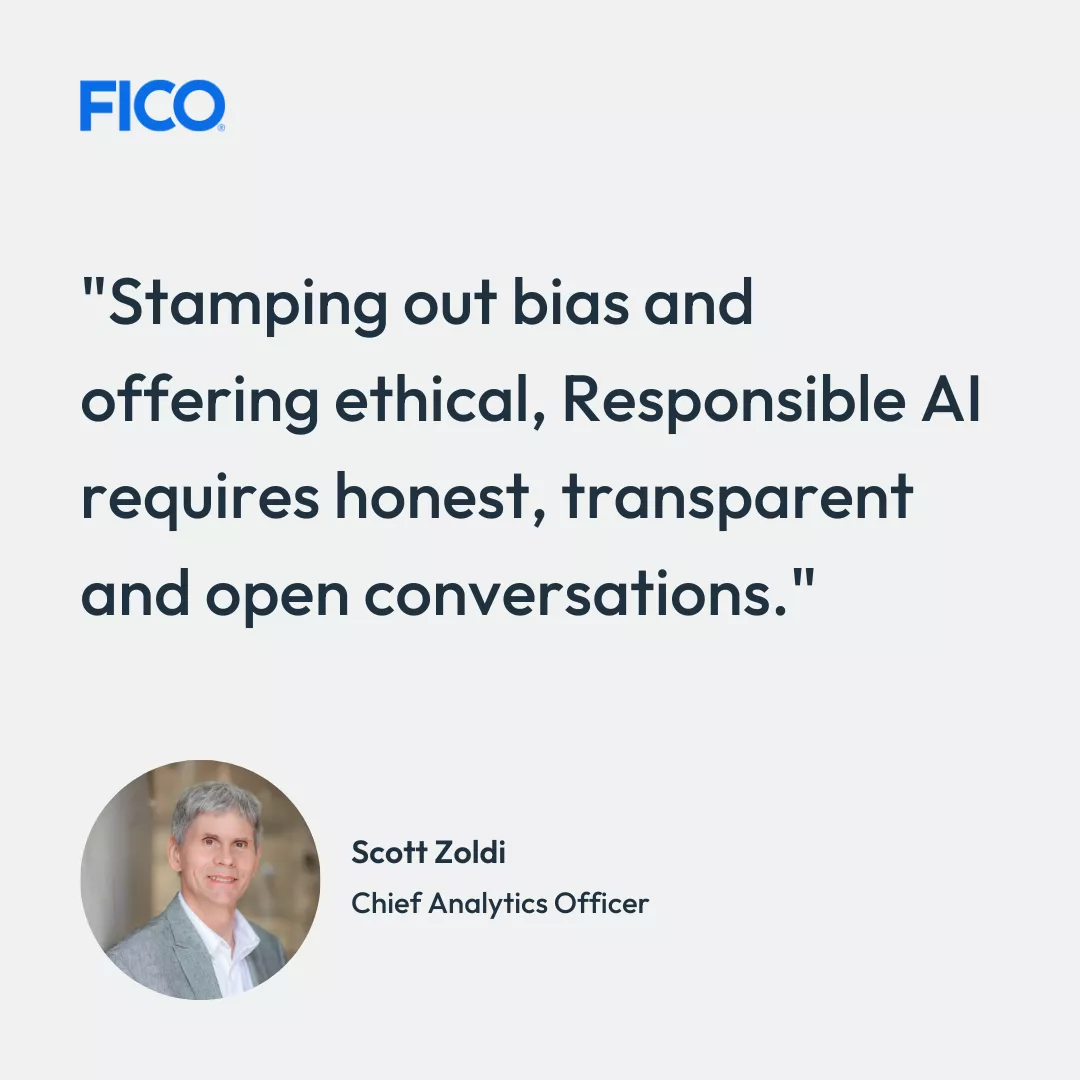
Stamping out bias and offering ethical, Responsible AI requires honest, transparent and open conversations; too often organizations want to talk about bias in an abstract way, not in the way that is directly impacting communities. As they worked through the analytics challenge, the students began to understand that by addressing bias in one group, they impact another. They also understand there’s no magic key to ending bias; it’s an evolutionary process that requires transparency and might take generations of AI models or data scientists to get to the right place. To be heard, the students recognize that they need to be part of that process, advocating and representing their communities. At FICO we are honored to take on the responsibility to empower and better prepare them to face these challenges in the field. In 2024 the FICO Educational Analytics Challenge will continue to help Black students find their voice.
How Responsible AI Helps Economies Grow
In 2023 I also had the privilege of sharing my ideas on Responsible AI with customers, colleagues and government organizations in Brazil, India and other countries, and continued learning from their perspectives. Many of these countries have gone through incredible large-scale digitization efforts, enabling new financial and payments systems and subsequent societal applications of AI. For example, Brazil presents a powerful case study for Responsible AI; over the past several years Brazil has made financial inclusion and transparency a national focus, to grow the economy and improve financial outcomes for individuals.
Brazil has enthusiastically embraced new technology to achieve these goals; FICO’s partner Belvo is using Responsible AI to power its open finance platform, providing life-changing access to credit to people who are completely unbanked. Consumer access to credit is proven to stimulate economies, and companies like Belvo are helping lenders responsibly extend credit to consumers who otherwise would not have options.
India presents another fascinating opportunity for economic growth. While credit card penetration in India is low (5.5% of the population, or 77 million people) compared to the US, where 82% of adults have at least one credit card, more than 78% of Indian citizens over age 15 have a bank account. Furthermore, India’s Unified Payments Interface (UPI) is driving broad digitization of payments, transforming cash-based societies into digital economies. UPI allows digital histories to be captured, enabling responsible participation in the financial system; huge portions of the society that were previously unbanked now create digital payment data streams that will fuel AI-driven decisioning models, driving better economic outcomes for all citizens.
Of course, fraudsters and scammers will be working overtime to exploit the massive adoption of digital payments globally. In 2024, I look forward to continuing to fight fraud, scams and financial crimes with innovations like the FICO Scam Detection Score, which identifies 24 times more scam transactions than a standard fraud detection model. We are always working to further improve the models we deploy, kicking off 2024 product announcements at the Fraud Forum this week in Indonesia, where I’ll present FICO’s latest Retail Banking Fraud / Scam model innovation to some of our fantastic clients in the APAC region.
Onward with Blockchain
Finally, in 2024 I plan to continue evangelizing the use of blockchain technology for Responsible AI and analytic model management governance. In 2023 FICO received a U.S. patent for this AI innovation, and I was honored to represent FICO in accepting a related Innovator award from Global Finance Magazine. Last week I was further energized to keep promoting this novel solution, which will be wrapped into FICO® Platform and available to customers, when I was featured in The Wall Street Journal, talking about AI and blockchain in “AI Has a Trust Problem. Can Blockchain Help?” I think you know my answer to that!
Cheers to an exciting 2024! Follow me on LinkedIn and X @ScottZoldi.
How FICO Can Help You with Responsible AI
- Read about FICO’s Blockchain Award - How to Use Blockchain to Build Responsible AI: An Award-Winning Approach
- Learn more at FICO® Responsible AI
- Download our AI Playbook: A Step-by-Step Guide for Achieving Responsible AI
- Review The State of Responsible AI in Financial Services

Popular Posts

Average U.S. FICO® Score at 716, Indicating Improvement in Consumer Credit Behaviors Despite Pandemic
The FICO Score is a broad-based, independent standard measure of credit risk
Read more
The GSE Data Is Public. Here's What It Shows About Credit Score Modernization.
Independent Milliman analysis of GSE historical data confirms what anyone can now verify directly: FICO® Score 10T is the most predictive score.
Read more
FICO® Score High Achievers: Is Age the Only Factor?
<p>FICO’s latest research on <a href="http://www.fico.com/en/blogs/risk-compliance/us-credit-quality-rising-the-beat-goes-on/" target="_blank">national FICO® Score distribution</a> shows that US credit quality continues to trend upwards, with an increasing number of consumers scoring in the highest scores ranges. Given that, we decided it was time to refresh our study on “<a href="http://www.fico.com/en/blogs/risk-compliance/infographic-what-does-a-high-credit-scorer-look-like/" target="_blank">FICO® Score high achievers</a>,” where we examine the credit behavioural profiles of consumers with higher credit scores.</p> <p>As expected, our latest study showed that older people generally have higher scores, as has been the case in our <a href="http://www.fico.com/en/blogs/risk-compliance/age-before-beauty-credit-worthiness-before-youth/" target="_blank">past research</a>. This is largely because they have trade lines that have been open longer, which leads to higher scores (assuming the trade lines are in good standing and all other things equal). The most credit savvy among you will remember that length of credit history accounts for roughly 15% of the overall <a href="http://www.myfico.com/CreditEducation/WhatsInYourScore.aspx" target="_blank">FICO® Score calculation</a>.</p> <p>But for younger consumers, it isn’t too helpful to say, “just wait until you are 50 years old, and that will fix things!” Thus, I decided to dive deeper with our analysis, including looking at the credit behavioural characteristics of younger consumers with high FICO® Scores.</p> <p>In this analysis, I looked at credit characteristics for the two highest score bands, 750-799 and 800-850, which have about 16% and 23% of the population, respectively. I further broke this down by looking at the characteristics of the youngest 15% in each group, which occurs at age 29 for the 750-799 group and 43 for the 800-850. We used FICO<strong>®</strong> Score 9 for our analysis, and examined typical variables of the categories that go into the make-up of the score.</p> <p><a href="http://www.fico.com/en/blogs/wp-content/uploads/2016/10/FICO-Score-High-Achiever-table.png"><img class="alignnone size-full wp-image-29367" src="http://www.fico.com/en/blogs/wp-content/uploads/2016/10/FICO-Score-High-Achiever-table.png" alt="fico-score-high-achiever-table" width="715" height="747" /></a></p> <p>Since there’s a lot to dissect in this chart, I’ll highlight a few findings that struck me: <ul> <li><strong>Credit history.</strong> Higher scores are undoubtedly associated with a longer time on file. What’s striking is the higher average time on file for the 800+ group, both overall and for revolving accounts (the most common trade line). Clearly, it helps to start credit use early in life – but that’s not the sole determining factor for high scoring. The younger cohorts in both the 800+ and 750-799 groups have time on file medians significantly less than their older counterparts.</li> <li><strong>New credit.</strong> High credit scorers do, in fact, pursue new credit. We see little variation in months since last trade line opening and last inquiry among all groups observed.</li> <li><strong>Pay on time.</strong> As you might expect, the further in the past the delinquency, the higher the score – and that’s <u>if</u> a delinquency ever happened. 95% of the 800+ people and 72% of the 750-799 group have never been delinquent, which is a striking contrast to the 57% for the total population. The percentages for the younger groups are even higher, especially so for the 750-799ers. Collection items are also scarce for these high scorers. While 23% of the national population have collection items greater than $99, the figures are only 0.5% for the 800+ group and 3% for the 750-799 group. It is clear that, in conjunction with starting a credit file early, paying on time is a key trait of the FICO® Score high achiever.</li> <li><strong>Balance and utilization.</strong> Finally, we look at how credit is being used, focusing on revolving product use. (Since most people only have one mortgage or one auto loan, variation in instalment product figures is minimal and driven by payment history, which is near perfect for high scorers, as we’ve seen.) FICO® Score high achievers tend to have more open revolving accounts. While the % active trades and utilization are generally lower, by no means do high scorers avoid the use of credit products. What drives the difference here is the amount of <u>available</u> revolving credit utilized. The 800+ group is roughly 1/4 of the national median, both in total and on their highest utilized card; they also have lower balances and more cards<em>. </em>The 750-799 group is more active and higher utilized, but still only at 2/3 of the national figures. The young 750-799 group compensate with lower revolving balances and, as a result, lower utilization, which is in line with what we see for the 800+ group.</li> <li><strong>Benchmarks.</strong> I’d like to point out that while this study provides good benchmarks of the typical credit traits of the FICO® Score high achiever, individual credit profiles will vary widely. And keep in mind that when we sort groups of consumers as a whole by different behaviours, some results may look superficially odd. For example, the 800+ band has a longer median average open account time (128 months) than average revolving months on file (140 months).</li> </ul> So, what do we conclude? A huge takeaway is that high scorers don’t have too much in the way of serious delinquencies and negative public record data.</p> <p>In most respects, the young 800+ people are like their peer group. They really only differ markedly in their shorter credit history and higher non-mortgage balance, both of which are a function of life stage. Our results show that you don’t have to be a credit product hermit; these high scorers have more credit cards. The takeaway is to start credit activity early and maintain well-managed and moderate usage.</p> <p>In many ways, the young 750-799 people are more interesting because their age profile is much younger. Their credit characteristics differ more from their peer group, particularly in terms of length of credit history. They compensate by having almost pristine credit records and lower balances.</p> <p>Ultimately, 39% of US consumers are FICO® Score high achievers, which they accomplish by following common-sense credit practices. It ain’t rocket science!</p>
Read moreTake the next step
Connect with FICO for answers to all your product and solution questions. Interested in becoming a business partner? Contact us to learn more. We look forward to hearing from you.