Measuring Financial Resilience: Edinburgh Scoring Conference
At the 2021 Edinburgh Credit Scoring conference, we will address scoring innovations that can improve decisions in all different economic scenarios


The last time I attended the Credit Scoring and Credit Control Conference at the University of Edinburgh in August 2017, my colleague Gerald Fahner and I spoke about two ostensibly different topics. In my presentation, “IFRS 9 – Comply and Compete,” I discussed how lenders could improve decisions across the consumer lifecycle by managing drivers of expected credit loss under the (then) new IFRS 9 international accounting standard. In Gerald’s talk, “Estimating Consumer Default Sensitivities to Financial Stress Factors Through Counterfactual Analysis,” he shared his research results regarding the range of changes in consumer payment performance in response to financial stress, uncovering latent portfolio risks that manifest during an economic downturn such as the Great Recession.
This year we will be revisiting and combining some of the same concepts from our earlier sessions. Gerald’s research presented in 2017 laid the foundation for the new FICO® Resilience Index, an innovative complement to traditional FICO® Scores that rank-orders consumers by their resilience to economic stress. We will provide an update of our latest analytic developments, including the major enhancements made to the latest release, FICO® Resilience Index 2, and how the score has performed during the pandemic economy. We will also share insights from early client adoption stories and best practice use cases of FICO Resilience Index to – once again – improve decisions across the consumer lifecycle, in all different economic environments. The analytics we will discuss can be especially useful in dealing with vulnerable customers.
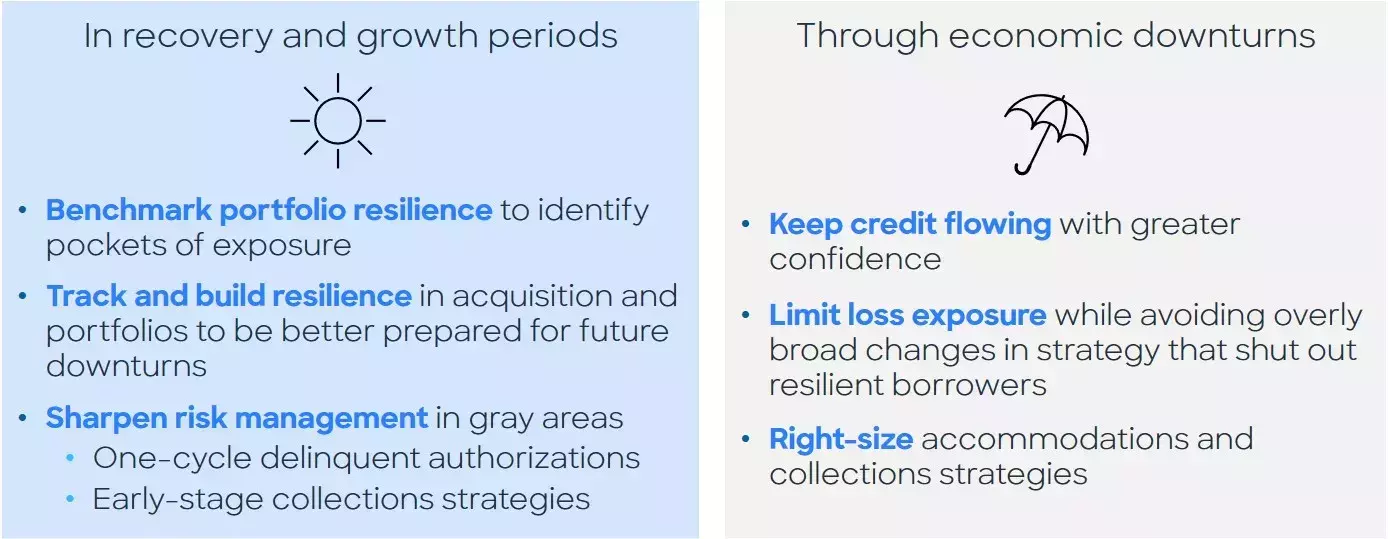
The FICO Resilience Index has benefits in all economic scenarios.
Sadly, the conference is entirely online this year due to ongoing COVID-19 restrictions, so I won’t be able to wander around Edinburgh again to learn more about its rich and sometimes tragic history. In my 2017 post-conference blog, I shared some insights from a guided tour about the city’s experience in 1645 dealing with its worst ever outbreak of bubonic plague, including the eerily prescient comment: “Who knows how many lives would have been saved with modern medical techniques and contagion modelling methodologies…”
Credit Scoring and Credit Control Conference XVII will take place between Wednesday August 25th and Friday August 27th, 2021. We hope you’ll attend what should be a fascinating conference. Seven sessions will feature FICO speakers, including our presentation, “Using Borrower Resilience to Inform Strategies Across the Credit Lifecycle and Across the Economic Cycle,” which will take place at 6pm UK time on Thursday, August 26th.
Please visit the FICO Blog to keep up to date on all of FICO’s latest insights and offerings, including our four-part series regarding the use of FICO® Resilience Index in decisions across the consumer lifecycle, “How to Address Portfolio Risk Volatility Through Economic Uncertainty.”
Popular Posts

Average U.S. FICO® Score at 716, Indicating Improvement in Consumer Credit Behaviors Despite Pandemic
The FICO Score is a broad-based, independent standard measure of credit risk
Read more
The GSE Data Is Public. Here's What It Shows About Credit Score Modernization.
Independent Milliman analysis of GSE historical data confirms what anyone can now verify directly: FICO® Score 10T is the most predictive score.
Read more
FICO® Score High Achievers: Is Age the Only Factor?
<p>FICO’s latest research on <a href="http://www.fico.com/en/blogs/risk-compliance/us-credit-quality-rising-the-beat-goes-on/" target="_blank">national FICO® Score distribution</a> shows that US credit quality continues to trend upwards, with an increasing number of consumers scoring in the highest scores ranges. Given that, we decided it was time to refresh our study on “<a href="http://www.fico.com/en/blogs/risk-compliance/infographic-what-does-a-high-credit-scorer-look-like/" target="_blank">FICO® Score high achievers</a>,” where we examine the credit behavioural profiles of consumers with higher credit scores.</p> <p>As expected, our latest study showed that older people generally have higher scores, as has been the case in our <a href="http://www.fico.com/en/blogs/risk-compliance/age-before-beauty-credit-worthiness-before-youth/" target="_blank">past research</a>. This is largely because they have trade lines that have been open longer, which leads to higher scores (assuming the trade lines are in good standing and all other things equal). The most credit savvy among you will remember that length of credit history accounts for roughly 15% of the overall <a href="http://www.myfico.com/CreditEducation/WhatsInYourScore.aspx" target="_blank">FICO® Score calculation</a>.</p> <p>But for younger consumers, it isn’t too helpful to say, “just wait until you are 50 years old, and that will fix things!” Thus, I decided to dive deeper with our analysis, including looking at the credit behavioural characteristics of younger consumers with high FICO® Scores.</p> <p>In this analysis, I looked at credit characteristics for the two highest score bands, 750-799 and 800-850, which have about 16% and 23% of the population, respectively. I further broke this down by looking at the characteristics of the youngest 15% in each group, which occurs at age 29 for the 750-799 group and 43 for the 800-850. We used FICO<strong>®</strong> Score 9 for our analysis, and examined typical variables of the categories that go into the make-up of the score.</p> <p><a href="http://www.fico.com/en/blogs/wp-content/uploads/2016/10/FICO-Score-High-Achiever-table.png"><img class="alignnone size-full wp-image-29367" src="http://www.fico.com/en/blogs/wp-content/uploads/2016/10/FICO-Score-High-Achiever-table.png" alt="fico-score-high-achiever-table" width="715" height="747" /></a></p> <p>Since there’s a lot to dissect in this chart, I’ll highlight a few findings that struck me: <ul> <li><strong>Credit history.</strong> Higher scores are undoubtedly associated with a longer time on file. What’s striking is the higher average time on file for the 800+ group, both overall and for revolving accounts (the most common trade line). Clearly, it helps to start credit use early in life – but that’s not the sole determining factor for high scoring. The younger cohorts in both the 800+ and 750-799 groups have time on file medians significantly less than their older counterparts.</li> <li><strong>New credit.</strong> High credit scorers do, in fact, pursue new credit. We see little variation in months since last trade line opening and last inquiry among all groups observed.</li> <li><strong>Pay on time.</strong> As you might expect, the further in the past the delinquency, the higher the score – and that’s <u>if</u> a delinquency ever happened. 95% of the 800+ people and 72% of the 750-799 group have never been delinquent, which is a striking contrast to the 57% for the total population. The percentages for the younger groups are even higher, especially so for the 750-799ers. Collection items are also scarce for these high scorers. While 23% of the national population have collection items greater than $99, the figures are only 0.5% for the 800+ group and 3% for the 750-799 group. It is clear that, in conjunction with starting a credit file early, paying on time is a key trait of the FICO® Score high achiever.</li> <li><strong>Balance and utilization.</strong> Finally, we look at how credit is being used, focusing on revolving product use. (Since most people only have one mortgage or one auto loan, variation in instalment product figures is minimal and driven by payment history, which is near perfect for high scorers, as we’ve seen.) FICO® Score high achievers tend to have more open revolving accounts. While the % active trades and utilization are generally lower, by no means do high scorers avoid the use of credit products. What drives the difference here is the amount of <u>available</u> revolving credit utilized. The 800+ group is roughly 1/4 of the national median, both in total and on their highest utilized card; they also have lower balances and more cards<em>. </em>The 750-799 group is more active and higher utilized, but still only at 2/3 of the national figures. The young 750-799 group compensate with lower revolving balances and, as a result, lower utilization, which is in line with what we see for the 800+ group.</li> <li><strong>Benchmarks.</strong> I’d like to point out that while this study provides good benchmarks of the typical credit traits of the FICO® Score high achiever, individual credit profiles will vary widely. And keep in mind that when we sort groups of consumers as a whole by different behaviours, some results may look superficially odd. For example, the 800+ band has a longer median average open account time (128 months) than average revolving months on file (140 months).</li> </ul> So, what do we conclude? A huge takeaway is that high scorers don’t have too much in the way of serious delinquencies and negative public record data.</p> <p>In most respects, the young 800+ people are like their peer group. They really only differ markedly in their shorter credit history and higher non-mortgage balance, both of which are a function of life stage. Our results show that you don’t have to be a credit product hermit; these high scorers have more credit cards. The takeaway is to start credit activity early and maintain well-managed and moderate usage.</p> <p>In many ways, the young 750-799 people are more interesting because their age profile is much younger. Their credit characteristics differ more from their peer group, particularly in terms of length of credit history. They compensate by having almost pristine credit records and lower balances.</p> <p>Ultimately, 39% of US consumers are FICO® Score high achievers, which they accomplish by following common-sense credit practices. It ain’t rocket science!</p>
Read moreTake the next step
Connect with FICO for answers to all your product and solution questions. Interested in becoming a business partner? Contact us to learn more. We look forward to hearing from you.