From Noise to Action: Why the Information-Action Ratio is the Hidden Crisis in Fraud Management
How banks can stop drowning in raw transaction data and get the context they need to make decisions that actually stop fraud

One of the critical problems facing fraud managers today is counter-intuitive. It isn’t the lack of information – it’s the abundance of information. More specifically, it’s the abundance of information without a clear action to take based on it.
This concept is known as the information–action ratio, a phrase coined by cultural critic Neil Postman in his book Amusing Ourselves to Death. At its core, it describes the relationship between a piece of information and what action, if any, a person who receives that information could reasonably be expected to take as a result of it.
A high information-action ratio refers to a situation where a person receives a great deal of information they can do nothing about. Postman expanded on this, warning that "information is now a commodity that can be bought and sold, or used as a form of entertainment... It comes indiscriminately, directed at no one in particular, disconnected from usefulness; we are glutted with information, drowning in information, have no control over it, don't know what to do with it."
Information-Action Ratio in the Age of AI
Postman's concept maps remarkably well onto the modern world of data, AI, and business — arguably more so than ever before. Businesses are flooded with information they can't meaningfully act on — which is now a documented crisis in business.
An Oracle study surveying over 14,000 employees and business leaders across 17 countries found that while 83% agreed that more data should make decisions easier, 86% said that in reality, more data has actually led to less confidence in their decision-making. A staggering 72% admitted that the volume of data and lack of trust had paralyzed their decision-making entirely.
AI compounds the problem in a very specific way. Cheap cloud storage incentivizes organizations to save everything, and AI tools — customer platforms, log analytics, generative AI agents — continuously create new records, summaries, and derivative outputs.
As more data feeds the model, the model generates more noise. Without rigorous curation, the signal gets buried — and decision-makers end up working harder just to find the same answers.
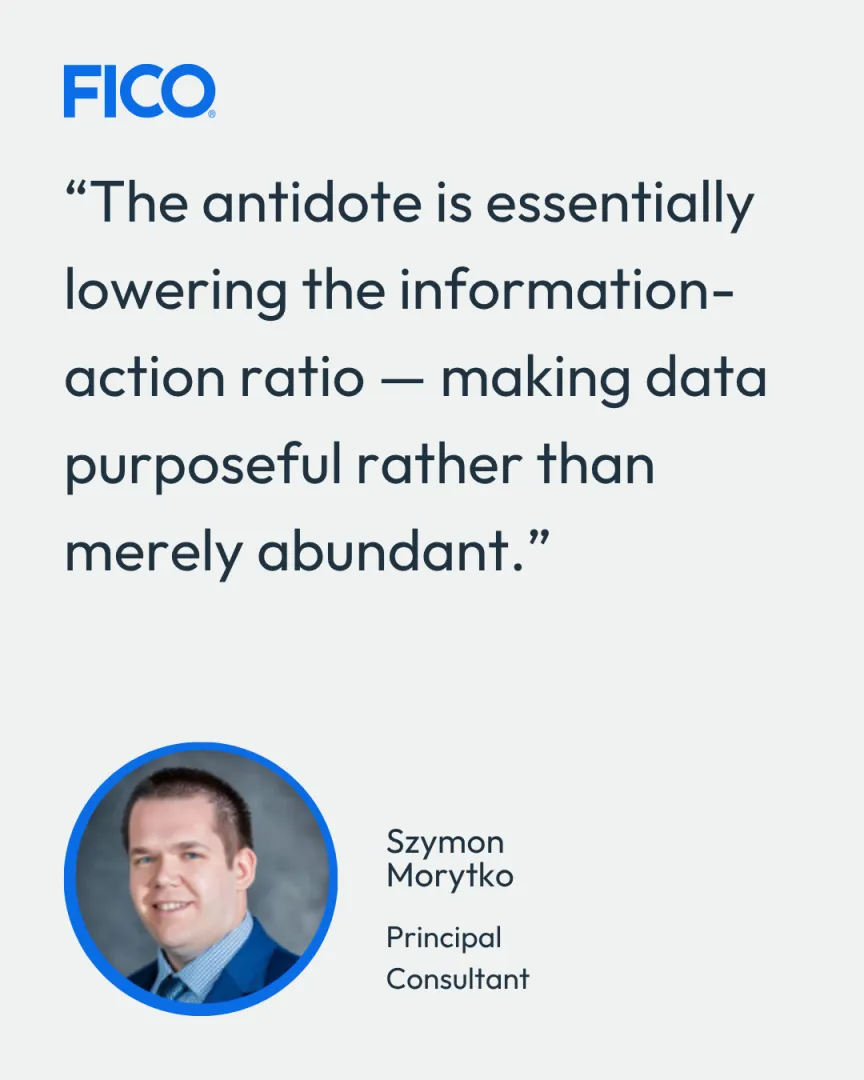
The antidote, according to modern practitioners, is essentially lowering the information-action ratio back down — making data purposeful rather than merely abundant. This means enforcing intent-based data collection (only collecting data with a clear business purpose and expiration date), using AI agents to handle the low-level sorting so humans can focus on synthesis, and generating actionable insights that can be orchestrated and used for decision-criticality rather than volume.
The goal is to use the right data when and where it can deliver the most value for customers and the enterprise.
Information-Action Ratio and Fraud Management
Fraud management is where the information-action ratio concept becomes not just intellectually interesting, but operationally critical — and the stakes are very high. In fraud and scam management, a poor information-action ratio doesn't just lead to paralysis; it directly enables financial crime, creates unnecessary customer friction, and impacts the business.
The information-action ratio problem hits differently across the three major fraud types facing banks today — card fraud, application fraud, and scams — but in each case the underlying failure is the same: raw signal arriving with no context that could drive a clear, confident and timely response.
Card fraud: the cost of getting it wrong in both directions
Card fraud is where the ratio problem is most immediately visible to customers, and where the consequences of imbalance run in both directions. Systems that are too loose miss fraud; systems that are too tight generate false positives that block legitimate transactions.
A good information-action ratio in card fraud therefore requires the system to distinguish not just what is suspicious, but what is suspicious for this specific customer, on this specific device, in this specific context. A $4,000 transaction from a customer who regularly makes $4,000 transactions should sail through. The same transaction from an account with no history of high-value purchases, on a new device, at 3am, should not.
The action attached to the information should be proportionate, precise, and grounded in behavioral context — not a blunt rule applied uniformly across millions of cardholders.
Application fraud: when the problem plays out over months
Application fraud — including first-party fraud, third-party identity theft, and synthetic identity fraud — presents a completely different version of the information-action ratio challenge. The problem here is not too many alerts in real time, but rather a failure to connect signals that accumulate slowly and across systems that don't talk to each other.
Synthetic identity fraud is the starkest example. Criminals combine real and fabricated identity components, pass KYC checks, and build a seemingly legitimate account history over months before executing a sudden, large bust-out event. Systems calibrated to minimize false positives in the short term will often whitelist these accounts precisely because their historical behavior looks clean.
The information was there — it was just decontextualised, scattered across devices, phone numbers, and IP addresses that the system never connected into a coherent picture.
A good information-action ratio in application fraud means linking those signals at the point of onboarding and throughout the account lifecycle, so the pattern is visible before the loss occurs rather than only explicable after the fact.
Scams: the big bad wolf
Scams — and Authorised Push Payment (APP) fraud in particular — represent perhaps the most acute information-action ratio challenge in all of financial crime, because the information that matters most arrives in a completely different channel to the transaction being made.
A customer being coached by a fraudster over the phone while simultaneously making a payment online is generating critical signals — but those signals are telephonic, behavioral, and psychological, not transactional. Traditional fraud systems, built to monitor payments data, are effectively blind to them.
A good information-action ratio in scam prevention means being able to detect that a customer is being actively manipulated while the manipulation is happening — and intervening in real time before the payment is made.
This requires enriching the payment signal with entirely new categories of intelligence:
- real-time telephony data indicating whether a customer is on a call during a transaction
- behavioral anomalies suggesting they are being coached through security processes
- contextual information behind the payment itself which can only be obtained through personalised communication with the customer
FICO's Scam Signal, developed with Jersey Telecom, does exactly this — using advanced real-time network data alongside customer and payment data to detect social engineering in progress, with early implementations delivering up to 41% reduction in people being scammed on real-time digital payments, a 44% decrease in gross scam fraud losses, and 55% fewer false positives
What Does a Good Information-Action Ratio Look Like in Fraud Prevention?
The goal is fundamentally to reconnect information to decisions — which means every alert that reaches an analyst should be one they can and should do something about. In practice, this means:
Precision over volume: The shift from rule-based systems that flag everything to AI-driven models that surface only genuinely anomalous behavior. The emphasis should be on fewer, higher-confidence alerts rather than exhaustive coverage that drowns analysts in noise.
Context-enriched signals: A raw transaction flag is low-ratio information. An alert that comes enriched with customer history, behavioral patterns, network links to known fraud typologies, and a recommended next action is high-ratio information — it tells the analyst not just that something is suspicious, but what to do about it.
Real-time decisioning: In fraud, the window between a signal and a meaningful action can be milliseconds — particularly in payments. A good information-action ratio in this context means orchestration systems, agentic AI and consortium models that can make a block/allow decision in real time, rather than generating a report that sits in a queue while a fraudulent payment clears.
Unified intelligence, not fragmented monitoring: Many institutions monitor individual channels, accounts, or products separately. This fragmented approach generates overlapping, disconnected alerts while missing the patterns that only become visible when you look across the full customer relationship. A unified view of a dynamic customer profile collapses the noise and surfaces the signal that actually matters.
AI and automation as the first-pass filter. Increasingly, the right approach is to use AI agents to handle the bulk of routine triage — deduplication, initial risk scoring, false positive filtering — so that human analysts are only engaging with cases that genuinely require human judgment. Using automated, hyper-personalised 2-way omni-channel communications with the ability to communicate through the right, trusted channel, at the right time, with the right type of personalised messaging is key in ‘breaking the spell of a scammer’.
Ultimately, the information-action ratio in fraud is a precision problem. Organizations often chase more data only to fail to capitalize on it, and then defer to deploying more rules, and more alerts that don’t yield the right results.
The organizations winning in fraud prevention are those that ask, for every piece of information generated:
- Who needs this?
- When is this needed?
- What insights can I gather from this?
- How can I use this to complement my fraud strategy?
- What specific action should it drive?
If the answer is unclear, it's either noise or you are missing the tools to make that data meaningful.
How FICO Can Help You Solve the Information-Action Ratio Problem
The information-action ratio problem in fraud (and other use cases) is a precision problem. Raw transaction data — volume, value, channel, time — tells you very little on its own. It only becomes actionable when it's understood in the context of who the customer is, how they normally behave, what's happening across other channels and products simultaneously, and what the broader threat landscape looks like. This is precisely what FICO Platform and FICO® Enterprise Fraud Solution are designed to deliver.
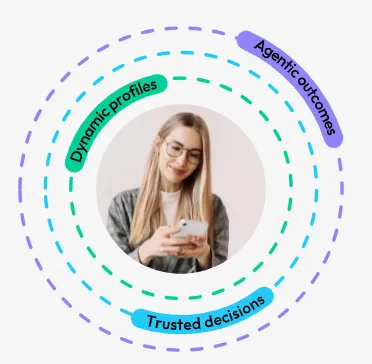
Dynamic profiles: knowing the customer deeply enough to trust a decision
The foundation of everything is the customer profile — and with FICO Platform, this is not a static record but a living, continuously updated picture built from every interaction across every touchpoint. FICO Platform builds real-time contextual profiles, summarising and profiling any entity with complex calculations and time-series aggregations, across accounts and devices.
These profiles are informed by behavioral patterns and trends — signals like "days since last purchase" or "number of transactions over a period of time" — that provide the contextual richness needed to tell a genuine customer from a fraudster.
Critically, FICO draws a distinction between negative and positive context. Most fraud systems focus narrowly on what looks bad — failed biometrics, changed phone numbers, unfamiliar devices.
But positive context is equally, if not more, important: understanding what the customer's normal looks like, their relationship depth with the bank, their typical transaction patterns, their known devices and locations. Without this positive context, any system will generate excessive false positives, because it lacks the full picture needed to confidently distinguish an unusual but legitimate transaction from a genuinely suspicious one
Orchestration: connecting the dots across siloed signals
The second dimension where FICO Platform creates value is orchestration — the ability to interlink different data sources, decision points, and treatment paths into a coherent, coordinated response. Fraud increasingly operates across channels simultaneously: a suspicious login here, an unusual payment there, a device change somewhere else. When these signals live in separate systems, they're individually ambiguous. Orchestrated together, they tell a clear story.
FICO enables orchestration across all products, portfolios, and channels, so enterprises can choreograph complex workflows at scale, and provides the ability to ingest and connect data from internal systems and external third-party sources via the FICO® Marketplace. This means a fraud decision is never made on a single signal in isolation — it's made on an orchestrated, enriched view of the customer and the transaction, informed by the widest possible set of relevant context.
Trusted decisions: explainable, governed, and auditable AI
The concept of a "trusted decision" in fraud goes beyond accuracy. For a decision to be truly trusted — by analysts, by regulators, by customers — it needs to be explainable, consistently applied, and auditable. FICO Platform is built with this in mind, and allows organizations to deploy fully interpretable models while providing end-to-end lineage and traceability across every decision made.
When a transaction is blocked or a case is escalated, the reasoning is visible and defensible — which is what regulators require and what compliance teams need to act with confidence rather than anxiety.
FICO describes this through the lens of "decision stewardship" — applying governance principles to execute compliant, trusted, outcome-aligned decisions. In fraud, this means every automated decision carries the weight of decades of domain expertise, global consortium data, and rigorous model governance behind it.
Agentic outcomes: turning every decision into the best possible experience
Perhaps the most powerful reframing FICO brings is that fraud management is not simply about stopping bad things — it's about value-driven outcomes for both the bank and the customer. The goal, as Adam Davies, vice president of Product Management at FICO puts it, is to turn a negative event into a positive customer experience. This is where the concept of "sensible friction" comes in: using orchestrated, contextual intelligence to apply exactly the right level of intervention for the right customer at the right moment — no more, no less.
A customer who is a known fraud victim requires a very different treatment from a first-time account takeover case. A high-value customer with decades of clean history and a purchase that matches a pattern seen before requires a different response than a newly onboarded account with no behavioral history.
By segmenting customers across both banking and fraud dimensions and orchestrating personalised responses accordingly, FICO enables fraud teams to move from reactive blocking to proactive, intelligent protection — raising the information-action ratio in the most meaningful sense: every decision is informed, trusted, appropriate to context, and connected to a clearly better outcome.
Don’t Let Your High Information-Action Ratio Paralyze You
Seen through Postman's lens, the chronic problem in fraud management has never really been a shortage of information — it has been an excess of decontextualised information that arrives disconnected from any clear action.
Banks drowning in alerts, analysts paralysed by false positives, compliance teams overwhelmed by noise: these are all symptoms of a broken information-action ratio.
What FICO Platform fundamentally does is repair that ratio — not by generating less information, but by transforming raw data into something categorically different: trusted, contextualised, orchestrated intelligence that arrives at the point of decision already carrying its own answer.
When a dynamic customer profile continuously synthesises behavior across every channel, when internal signals are orchestrated alongside external intelligence from the world's largest fraud consortium, and when AI models with 30 years of pattern recognition distil all of that into an explainable, auditable decision in milliseconds — the gap between information and action collapses.
Fraud analysts no longer wade through a feed of disconnected signals about things they can do nothing about. Instead, every alert that reaches them is meaningful, every decision they make is grounded in the fullest possible picture of who the customer is and what is actually happening, and every outcome — whether that's blocking a fraudster, protecting a scam victim, or letting a legitimate customer transact without friction — is the best one available given the evidence.
That is what a truly optimised information-action ratio looks like in practice, and it is precisely the competitive and protective advantage that FICO Platform is built to deliver.
How FICO Can Help You Stop Fraud
- Understand more about modern approaches to enterprise fraud with the six E’s of enterprise fraud
- Explore our fraud solutions
- Explore the power of FICO Platform

Popular Posts

Has the Reporting of Rental Data to the Credit Reporting Agencies (CRAs) Increased?
FICO Score 10T includes rental data, but consumers can only experience the benefit of this to the extent that their rental data is reported to the CRAs
Read more
Average U.S. FICO® Score at 716, Indicating Improvement in Consumer Credit Behaviors Despite Pandemic
The FICO Score is a broad-based, independent standard measure of credit risk
Read more
Average U.S. FICO Score at 717 as More Consumers Face Financial Headwinds
Outlier or Start of a New Credit Score Trend?
Read moreTake the next step
Connect with FICO for answers to all your product and solution questions. Interested in becoming a business partner? Contact us to learn more. We look forward to hearing from you.