Collection Strategies: Best Practices for the Digital Age
From early outreach to late-stage recovery, see how analytics, AI and the right KPIs can improve your collections rate and protect customer relationships

Collection strategies built for yesterday’s borrower are losing ground. Rising interest rates, high unemployment, and escalating food and energy prices are squeezing household budgets. Many borrowers are struggling to service home loans, vehicle loans, credit cards and overdrafts. Late payments rise as disposable income falls.
Adding digital tools to an old operating model does not solve this. Lenders need a collections strategy that treats early-stage and late-stage delinquency differently, uses analytics and AI to match each treatment to the customer, and measures success with the right KPIs. This guide covers the practices that help improve the collections rate while protecting the customer relationship.
Key Takeaways
- Begin with the decision outcome. Align every element of the strategy with a defined business objective.
- Segment with data, not balance alone. Assigning the costliest action to the largest debt may not maximize recovery. Use analytics to match each treatment to the debtor’s profile.
- Place the customer at the center. Personalized outreach and early hardship identification support both recovery and long-term customer value.
- Engage customers digitally. Omnichannel communication and self-service enable customers to resolve their accounts on their own terms.
- Test and improve continuously. Validate changes through challenger strategies and control groups, then optimize across cure rate, roll rate and operational cost.
- Apply AI at every stage of delinquency. AI identifies early risk signals and predicts payment behavior, while automation handles routine conversations. Human collectors are then free to focus on the cases that need judgment.
What Are the Fundamentals of a Modern Collections Strategy?
A successful collection strategy in today's environment requires a comprehensive understanding of multiple factors that influence debtor behavior and collection outcomes. Modern collection strategy design must consider event severity, value, duration, recency, customer intent, and both ability and willingness to remediate debt situations. Also, in many markets regulators have recently put a strong focus on fair outcomes that take into account debtor’s financial capacities.
Financial institutions need to move beyond traditional approaches and develop collection strategies that are both data-driven and customer-centric. This means:
- Leveraging advanced analytics to segment portfolios effectively
- Implementing targeted approaches based on specific debtor profiles and circumstances.
What is the Difference Between Early-Stage and Late-Stage Collections?
The priorities in a collections strategy shift as an account moves through the delinquency cycle. Each stage has a distinct objective and calls for a different treatment.
Early-stage collections focus on:
- Reminding customers and enabling self-cure
- Preventing deterioration
- Choosing the right channel, timing and tone
Late-stage collections focus on:
- Resolving the payment issue
- Avoiding charge-off, disconnect or write-off
- Deciding whom to restructure, how, and with what offer
How Does AI Support Early-Stage and Late-Stage Collections?
AI supports each stage in a different way. In early collections, the aim is to act before a missed payment becomes a roll. AI helps to identify early risk signals, predict payment behavior, derive segmentation and assess financial capacity. Analytics-based segmentation then determines the appropriate treatment intensity and prioritizes work. Standard conversations, such as reminders and payment agreements, can be automated, with escalation to human collectors where required. Early-stage decisions rely on models such as the probability of cure and the probability of roll.
In late collections, models such as probability of default (PD), expected loss (EL), net present value (NPV) and expected cash support restructure decisions. By pinpointing high-risk accounts and predicting their likelihood of responding to specific collection strategies, businesses can allocate their resources more efficiently. Conversational AI also frees agents to focus on the cases that need human intervention.
Why Collection Strategy Design Requires Continuous Evolution
Collection strategy design needs to keep evolving because customers, economic conditions and regulations keep changing. A strategy built on yesterday’s assumptions will miss today’s behavior. Strategies that still rely on static segmentation and fixed treatment paths apply the same rules to highly varied customer populations, and that approach no longer holds up.
AI and machine learning address this by analyzing large datasets continuously and adjusting treatments in real time as economic conditions and customer behavior shift.
The cost of standing still is measurable. In auto lending, recovery probability falls to roughly 70% after three months and only 50% after six months when communications are ineffective.
How Are Debtor Behavior and Expectations Changing?
Debtors now expect personalized, digital-first treatment, and their behavior shifts well before a payment is missed.
Understanding current spending and repayment trends for each client and product portfolio is crucial for effective debt allocation. Consumer behavior has shifted significantly, particularly with the rise of digital-first interactions and changing economic pressures. Customers do not move suddenly from financial health to delinquency. They travel through a period of strain first, often over weeks or months, adjusting their behavior in ways that are visible. Collection strategies must adapt to these evolving debtor profiles and preferences.
Modern debtors exhibit different communication preferences, payment behaviors, and financial management approaches compared to previous generations. FICO research found that 38% of telco customers prefer text messaging over phone calls (30%), 20% choose email, and 12% favor WhatsApp or messaging apps. They expect:
- Personalized interactions - Customers experiencing financial stress expect to engage on their own terms. They want control over timing and channel.
- Multiple payment options- Customers want flexibility in how and when they pay.
- Respect for their circumstances - The vast majority of customers who fall into arrears are experiencing temporary difficulties, not long‑term default behavior.
Collection strategies must evolve to meet these expectations while maintaining effectiveness.
Economic and Regulatory Adaptation
Regulation changes how you can contact customers. Economic shifts change whether they can pay.
Regulatory change
Changes in regulation require immediate adjustment to contact approaches and collection methodologies. Recent regulatory changes have emphasized fair treatment of customers in financial difficulty, requiring collection strategies to incorporate more sophisticated assessment mechanisms for hardship and vulnerability. Regulators have charged 7- to 8-digit fines to some banks. Institutions must demonstrate that hardship disclosures are acknowledged appropriately; that complaints are handled in line with regulatory requirements; and that treatment is consistent across interactions and over time. Organizations must ensure their strategies remain compliant while achieving collection objectives.
Economic change
Economic fluctuations influence debt dynamics and directly impact debtors’ ability to repay. A macro-economic downturn typically brings higher inflow, more difficult collections and higher losses. A redundancy, a health event, a relationship breakdown or a sharp rise in mortgage repayments can push a previously reliable borrower into temporary financial stress. Most borrowers will recover. Many will self-cure without requiring significant intervention, provided they are identified early and supported proportionately.
A robust collection strategy must be flexible enough to adapt to these external changes while maintaining compliance and effectiveness.
AI Technology Integration and Automation
The rapid advancement of collection technology creates both opportunities and challenges for strategy development. Organizations must continuously evaluate new technologies and integrate them into their collection strategies where appropriate, while ensuring that human elements remain where they add the most value.
AI and automation capabilities have expanded significantly, enabling organizations to handle routine collection activities more efficiently while freeing up human resources for complex cases requiring personalized attention. Collection strategies must balance automation with human interaction to optimize outcomes across different debtor segments.
The Strategic Framework for Collection Strategy Design
A strong framework starts with the outcome and works back to the data, models and treatments. When developing a collection strategy, organizations must begin with the decision outcome in mind. This fundamental principle ensures that every element of the strategy aligns with specific business objectives, whether the goal is to increase returns, build customer trust, reduce risk of account deterioration, or achieve multiple outcomes simultaneously.
Understanding the priority of objectives is equally crucial. For instance, collectors working with high-value accounts may prioritize relationship preservation over immediate payment collection, while those handling smaller accounts might focus on efficiency and automation. This strategic clarity forms the foundation for effective collection strategy implementation across different portfolio segments.
Data-Driven Collection Strategy Development
Making decisions that can impact the success of your business comes down to good use of information. More information allows for more informed and better decisions. Accurate, relevant, current and detailed data is essential for designing effective collection strategies.
When reviewing data requirements for collection strategy development, organizations must consider several critical elements:
Timeframes and Performance Windows
Identifying the period of time used as a gauge for decision-making is fundamental. Most collection strategy projects pull data from a previous observation date and review performance at a later performance date. Having multiple observation and performance snapshots available in your dataset allows for building more stable strategies that can be appropriately segmented.
Data Quality and Completeness
The effectiveness of any collection strategy depends heavily on the quality and completeness of underlying data. Organizations must invest in data cleansing, validation, and enrichment processes to ensure their strategies are built on reliable information foundations.
Real-Time Data Integration
Modern collection strategies require real-time data feeds that enable dynamic decision-making. This includes payment behavior updates, communication behavior and preferences, financial status changes, and external economic indicators that might affect debtor circumstances.
Advanced Analytics in Collection Strategy Design
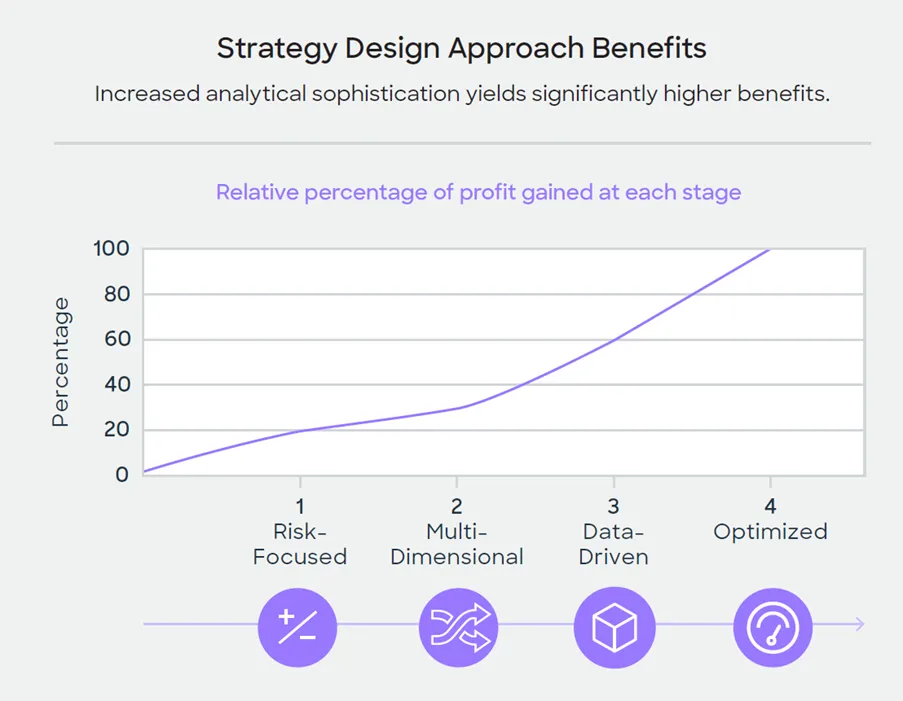
The evolution toward data-driven collection strategies has created significant opportunities for organizations willing to invest in advanced analytics capabilities. Increased analytical sophistication yields significantly higher benefits, with optimization representing the pinnacle of strategic effectiveness.
- Multi-Dimensional Analysis: Moving beyond simple risk-focused approaches, effective collection strategies incorporate multi-dimensional analysis that considers customer value, relationship history, payment patterns, communication preferences, and external economic factors. This comprehensive view enables more nuanced and effective collection approaches. Australia’s ANZ bank provides a clear example of what becomes possible when financial stress is made continuously observable at scale. By implementing daily transaction scoring across more than 7 million retail and SME customers, the bank moved beyond periodic credit assessment to continuous behavioral insight. The system analyzes billions of transactions over a 12-month rolling period, enabling earlier detection of emerging financial stress than monthly scoring would allow.
- Predictive Modeling Capabilities: Advanced collection strategies leverage predictive modeling to forecast payment behavior, optimal contact timing, and most effective collection actions. These models continuously learn from outcomes and adapt to changing portfolio characteristics and economic conditions.
- Machine Learning and Optimization: The integration of machine learning algorithms allows collection strategies to identify patterns and relationships that might not be apparent through traditional analysis methods.
- Decision Optimization: Sophisticated approaches model debtors’ reactions to applied collection treatments and allow a detailed quantitative understanding of trade-offs between competing targets such as cure rate, roll rate and operational costs. This allows you to scientifically derive a strategy that leads to optimal results in terms of a certain KPI, while honoring limits for alternative metrics.
How to Realign Yesterday's Collections Structure to Meet Today's Needs
Significantly higher volumes of accounts are entering collections, which inevitably puts pressure on operations, forcing many clients to rethink their operating models. Organizations are dealing with questions around insource versus outsource, digital versus dialer, restructure versus legal approaches.
Legacy systems add to the pressure. Traditional communication systems often lack the flexibility, speed, and interoperability needed to support real-time, omni-channel, AI-driven communication. Data silos, manual processes, and outdated architectures make it difficult to deploy NLP-based technology or manage customer interactions cohesively across touchpoints. To overcome these limitations, organizations need AI-powered engagement platforms such as the FICO Platform that can integrate with, or layer on top of, existing infrastructure, enabling transformation without requiring a full system overhaul.
Performance Variables in Collection Strategy Design
When developing effective collection strategies, organizations must focus on comprehensive performance variables that go beyond simple risk assessment. These variables should evaluate multiple outcomes including proportion of debt repaid, cost of collection operations, revenue generation, profit optimization, customer retention rates, and compliance scores.
Understanding that outcomes such as recovered percentage may have an inverse relationship with the amount of debt is crucial. Simply assigning the most expensive collection actions to the highest debts may not yield the highest recovery rates. Successful collection strategy design requires a holistic view that customizes features around specific portfolio characteristics.
Which Collections KPIs Should You Track?
The success of collections strategies should be measured by more than the amount recovered. Key collections KPIs include:
- Proportion of debt repaid: shows how much of the outstanding balance is actually recovered.
- Balances cured: shows how many delinquent balances return to a current status.
- Balance roll rates: show whether accounts are deteriorating from one delinquency stage to the next.
- Cost of collection operations: shows the effort and expense needed to achieve each result.
- Revenue generation: shows the income preserved or generated through collection activity.
- Customer retention rates: show whether customers stay after a collections interaction.
- Promise-to-pay fulfillment rates: show how often customers keep the commitments they make.
- Compliance scores: show whether results are achieved within regulatory and policy requirements.
Regular reviews should also analyze the correlation between collection actions and customer churn.
Customer Experience as a Strategic Priority
Customer experience is becoming a key focal point in collection strategy development. Historically, customer experience has been a key driver during the onboarding process, but organizations are realizing that applying the same approach to collections is also proving a successful route to maximizing the lifetime value of customers.
Many organizations are opting for a far more customer-centric approach, with more focus being placed on preferences and understanding a customer's specific needs, while providing solutions that are suitable for both the customer and the lender's risk appetite.
This shift toward customer-centricity in collection strategies involves:
- Personalized Communication Strategies: Tailoring communication approaches based on individual customer preferences, communication history, and demonstrated responsiveness to different message types and channels.
- Hardship identification: Target evaluation of the customer situation identifying eventual vulnerabilities and hardship and assessing the financial capacity of the debtor.
- Flexible Payment Solutions: Offering various payment options that accommodate different financial situations, including extended payment plans, reduced settlement options, and alternative payment methods that align with debtor capabilities.
- Proactive Engagement: Implementing strategies that reach out to customers before they fall into significant delinquency, offering assistance and alternative arrangements that prevent account deterioration.
Westpac New Zealand’s platform-driven transformation illustrates what getting lifecycle management right looks like in practice. By moving from account-level decisions to managing customers holistically across their entire relationship, the bank improved consistency of treatment, strengthened coordination across collections, credit, and servicing, and demonstrated the ability to respond rapidly to emerging needs. During Cyclone Gabrielle in 2023 and the subsequent period of cost-of-living pressure, Westpac NZ was able to introduce hardship support in near real time rather than waiting for processes to catch up with customer reality.
What Does Digital Transformation Mean in Collection Strategies?
The digital transformation of collection strategies encompasses multiple dimensions that organizations must address comprehensively:
- Omnichannel Integration: Modern collection strategies must seamlessly integrate across multiple communication channels, providing consistent experiences whether customers interact via phone, email, text message, mobile app, or web portal. Each channel should provide accurate, up-to-date account information and enable customers to take action toward resolution.
- Self-Service Capabilities: Implementing robust self-service options allows customers to manage their accounts, make payments, set up payment arrangements, and communicate with collection teams on their own terms. This approach reduces operational costs while improving customer satisfaction and engagement.
- Real-Time Decision Making: Collection strategies must incorporate real-time decision-making capabilities that can adjust approaches based on current customer circumstances, recent payment behavior, and external factors that might influence collection outcomes.
Two-Way Digital Dialogue Will Always Speak Volumes to Customers
The shift from traditional one-way communication to interactive digital dialogue represents a fundamental change in collection strategy approach. Modern debtors expect personalized, respectful communication that is available 24/7, acknowledges their individual circumstances and provides flexible resolution options.
In the past, customer communications were there to take stock of accounts in collections and target them with more or less specific campaigns. While there may have been some one-directional digital channels like text or email, the bulk of activity was underpinned by a big dialer, which is still prevalent in many markets.
Despite its commercial popularity, it has subsequently proved not to be the best channel to speak to customers – highlighted by consumer activity at the height of the pandemic. But now, the industry is moving on at pace with technological step-changes in stronger analytics, faster, smarter omnichannel engagement, data streaming and real-time triggers, contacting customers at the best time to engage rather when there is capacity in the call center. All of these help inform the most appropriate strategy execution by leveraging data and analytics with optimization to deliver the right solutions in place.
Auto-Resolution and Customer Self-Service
Auto resolution quickly becomes attainable at scale by enabling customers to self-serve at any time thanks to orchestrated, bi-directional omnichannel solutions. This capability transforms the traditional collection model from one that relies heavily on agent intervention to one that empowers customers to resolve their situations independently while maintaining access to human support when needed.
Modern collection strategies must consider the customer's preferred communication channel and timing, providing options that fit within their daily routines and preferences. This might include evening text message reminders for customers who work during traditional business hours, or email communications for those who prefer written documentation of their payment arrangements.
Testing and Optimization in Collection Strategy
Challenger Strategy Implementation
Developing good practices around treatments and testing new approaches through challenger strategies are crucial steps in determining the best actions to take. Significant insights can be gained during strategy design through systematic testing of different approaches across comparable portfolio segments.
For example, a U.S. retailer once rejected new authorizations on delinquent accounts. By creating a challenger strategy that identified low-risk but late-paying customers, the company allowed new authorizations on selected accounts. The result? Millions of dollars in incremental sales in just one month, sales that would have been lost under the old approach.
The ability to combine policies with data-driven splits is crucial to solid strategy design, as is the ability to view multiple performances side by side to compare segments. Both help users adjust splits more effectively and then assign appropriate treatments based on objectives.
A/B Testing Framework
Implementing robust A/B testing frameworks allows organizations to compare different collection approaches scientifically, measuring not only immediate collection outcomes but also customer satisfaction, complaint rates, and long-term relationship impacts.
Control Groups and Statistical Validation
Maintaining appropriate control groups and ensuring statistical significance in testing results prevents organizations from implementing changes based on random variation rather than genuine improvement in collection strategy effectiveness.
Continuous Improvement Methodologies
Collection strategies must incorporate continuous improvement methodologies that systematically evaluate performance and identify optimization opportunities. This includes regular strategy reviews, performance benchmarking, and integration of lessons learned from both successful and unsuccessful collection attempts.
Organizations should establish feedback loops that capture insights from front-line collection staff, customer feedback, and operational metrics to continuously refine their strategies. This iterative approach ensures that collection strategies remain effective as portfolio characteristics and economic conditions evolve.
Future-Focused Collection Strategy Development
- Predictive Analytics: Advanced predictive models can forecast payment behavior, optimal contact timing, and most effective collection messages based on historical performance data and external economic indicators.
- Mathematical Optimization: This technology applies advanced analytics to determine the best decision strategy, based on goals and constraints. For example, loan restructure optimization uses mathematical optimization to identify which customers should receive a restructure offer, and which offer should be made. It balances the need to increase loan Net Present Value with take-up probability and re-default rates. Because it can balance multiple objectives and constraints, it’s better than simplistic restructure campaigns based on a couple of policies, and avoids high re-default rates caused by judgmental selection of the right restructure solution.
- Artificial Intelligence and Machine Learning Integration: The future of collection strategy lies in the sophisticated application of artificial intelligence and machine learning technologies that can process vast amounts of data to identify the best collection approaches for individual accounts. These technologies enable dynamic treatment adjustment based on real-time data and changing customer circumstances.
- Natural Language Processing: Integration of natural language processing capabilities enables more sophisticated analysis of customer communications, identifying sentiment, intent, and circumstances that inform optimal collection approaches.
- Regulatory Technology Integration: As regulatory requirements become more complex and stringent, collection strategies must incorporate regulatory technology (RegTech) solutions that ensure compliance while maintaining collection effectiveness. This includes automated compliance monitoring, documentation of customer interactions, and real-time assessment of regulatory requirements across different jurisdictions.
How to Build Resilient Collection Strategies
- Economic Adaptability: Collection strategies must be designed with economic adaptability in mind. This includes stress-testing strategies against various economic scenarios and building flexibility into treatment allocation and escalation processes.
- Scenario Planning: Developing collection strategies that can function effectively across different economic conditions ensures organizational resilience and maintains collection performance during challenging periods.
- Dynamic Portfolio Management: Implementing dynamic portfolio management capabilities allows organizations to reallocate resources and adjust strategies based on changing portfolio performance and external economic factors.
Long-Term Relationship Focus
Modern collection strategies must also balance immediate collection objectives with long-term customer relationship value. This involves considering the lifetime value of customers when designing collection approaches and ensuring that collection activities support rather than undermine ongoing customer relationships.
- Customer Retention Metrics: Incorporating customer retention and satisfaction metrics into collection strategy evaluation ensures that short-term collection gains don't come at the expense of long-term customer value.
- Rehabilitation Programs: Developing comprehensive rehabilitation programs that help customers restore their financial standing while maintaining positive relationships with the organization creates win-win outcomes that support both collection objectives and customer loyalty.
Taking Collection Strategies from Standard to Best Practice
Let's look at where most collections strategies are now and what the future should look like.
Standard Collections Strategies
- Basic analytics – bureau scores, behavior score, predicted roll to default, originations score for new customers.
- Product-level view – with minimal to no view of other product holdings or history of collections activity on those products.
- Campaign structure – this is the focus, still driven by month-end decisioning and working in 30-day blocks. The dialer has become the decision engine!
- Multichannel – multiple independent channels with no integrated dialogue between the differing messages, resulting in hectoring of customers.
- Policy rules OK – the lack of analytic insights and data-driven rules means policies are used as a safety net.
- Limited forbearance tools – predominantly term extension, no ability to use the differing instruments of restructure – interest, arrears, principal, term, step ups, balloons, settlement.
Advanced Collection Strategies
- Cycle-specific predictive analytics – used from cycle to cycle or better to avoid IFRS9 stages. We recommend more analytics focused on predicting in-cycle customer behavior to drive strategies for digital, dialer and placement.
- Customer centric:
- View – all products and relationship data, allowing for a fully rounded view
- Events – synergy of treatment and relevance if holding more than one product.
- Engagement – communication pulse across all activity, not just collections
- Forbearance treatments – based on reason for delinquency, duration of impact and disposable income – true understanding of the customer’s circumstances.
Best Practice Collection Strategies
- Real-time prescriptive decisioning – driving best next action and extending across the in-house and outsourced collection treatments.
- Optimization – the most optimal decision targeted at an objective goal with quantification of constraints, across contract strategies, forbearance treatments and restructure, as well as work/place/sell decisions in recoveries.
- Bi-directional auto resolution – let those that will self-serve do so, efficiently, conveniently, with confidence and trust. Aim for full self-serve forbearance.
- Dynamic forbearance – how dynamic can you be to retain future good customers? From payment breaks and arrears capitalization to house swap to repo avoidance optimization.
Conclusion: The Strategic Imperative for Modern Collections
The collections industry stands at a critical juncture where traditional approaches are becoming obsolete, and new, digitally enabled strategies are essential for success. Organizations that embrace data-driven collection strategy design, prioritize customer experience, and maintain flexibility to adapt to changing conditions will emerge as leaders in this evolving landscape.
As economic pressures continue to challenge both lenders and borrowers, the organizations that thrive will be those that can implement sophisticated, data-driven collection strategies that demonstrate empathy for customer circumstances while maintaining the discipline necessary to protect organizational financial health.
In practice, this means acting early to prevent deterioration, matching each late-stage account to the right treatment, using AI to scale personalized engagement, and tracking KPIs that balance recovery with customer value. Together, these steps help improve the collections rate while protecting the customer relationship.
How FICO Platform Can Advance Your Digital Debt Collection Strategies
- See our solutions for debt collection and recovery
- Download our executive brief to see how an automated collections strategy converts the 23% of customers who forget to pay — using digital-first omnichannel automation that reduces costs without damaging customer relationships.
- Download our white paper to understand how collections and recovery analytics streamlines debt management, reduces risk, and maximizes recovery rates.
- Read our white paper to see how digital-first debt collection strategies helped Westpac NZ achieve a 40% cost reduction and 25% increase in digital engagement.
- Watch our FICO World 2026 presentation to see how integrated collections orchestration across decisioning, optimization and omni-channel communications reduces operational effort by up to 20% while substantially reducing balance rolling across your portfolio.
- Discover how StepChange modernized its decisioning with FICO Platform to deliver real-time personalized advice across 15+ debt types, reducing strategy change time from days to minutes.
- As delinquency risks rise and portfolios become more complex, traditional manual processes are proving increasingly difficult to scale and manage effectively. Access the white paper to learn how automation, advanced analytics and digital workflows help lenders improve operational efficiency, accelerate resolution timelines and respond more effectively to evolving borrower risk profiles.
This is an update of a post from 2025.
Frequently Asked Questions
The decision is best made account by account, not for the portfolio as a whole. Institutions typically weigh the expected recovery from each account against the cost of working it, the level of control and customer care it requires, and the compliance obligations that apply. Accounts that need relationship sensitivity or careful handling of hardship are often kept in-house, while others may be placed with external partners. Whichever route is chosen, institutions should set clear performance targets, monitor results and keep treatment consistent across both channels.
Lenders prove compliance by monitoring how customers are treated, not only by documenting policy. Institutions that sample 5% or 10% of interactions are blind to most of what happens in their collections environments, so inconsistencies and missed hardship signals go undetected. The shift required is from retrospective review to continuous monitoring. A proof of concept with a major Australian bank moved from partial sampling toward near-complete visibility of how collections teams responded to customers in vulnerable situations.
Fraud cases contaminate collections processes, waste resources and skew financial models. Separating them lets teams focus collection effort on recoverable debt and route fraud cases to the appropriate remediation process. It also improves financial accuracy, because fraud and collectible debt are categorized correctly.
The main considerations are transparency, bias detection and human accountability. Decisioning logic has to be transparent and explainable, and AI should operate within a governance architecture that preserves meaningful human accountability for outcomes. This matters most in hardship conversations, fraud disputes and scam interventions. FICO has been operationalizing explainable and responsible AI for more than 20 years in credit risk and fraud detection, including methodologies for bias detection and model governance.

Popular Posts

The GSE Data Is Public. Here's What It Shows About Credit Score Modernization.
Independent Milliman analysis of GSE historical data confirms what anyone can now verify directly: FICO® Score 10T is the most predictive score.
Read more
Average U.S. FICO® Score at 716, Indicating Improvement in Consumer Credit Behaviors Despite Pandemic
The FICO Score is a broad-based, independent standard measure of credit risk
Read more
FICO® Score High Achievers: Is Age the Only Factor?
We've refreshed our study on the credit behavioural profiles of consumers with higher FICO Scores, with a strong focus on younger consumers.
Read moreTake the next step
Connect with FICO for answers to all your product and solution questions. Interested in becoming a business partner? Contact us to learn more. We look forward to hearing from you.