Top 5 Decision Management Posts of 2021
The 5 top posts last year dealt with digital transformation in insurance, automated originations, responsible AI, model governance and, strangely enough, movies!

The technology of advanced decision management is changing rapidly, as businesses worldwide pursue automated, analytics-powered decisions as an essential part of their digital transformation. The 5 top posts for decision management on the FICO Blog last year dealt with digital transformation in insurance, automated originations, responsible AI, model governance and, strangely enough, movies!
Here are extracts from those posts.
Digital Transformation and the Future of Insurance
Kevin Deveau wrote: Digital Insurance – a leading publication serving the insurance automation and decisioning industry – conducted a survey of insurance industry executives, asking them to share their companies’ concerns about digital disruption and their progress towards digital transformation. The results of the survey were both illuminating and sobering. For example,
- 81% of insurers believe that digital disruption poses a threat to the industry
- In every category measured in the survey, Health and Life insurers were significantly more confident in their digital transformation progress than Multi-line and P&C insurers
- In terms of data democratization, 65% of Health and Life insurers reported that they have empowered business users, versus just 35% for Multi-line and P&C insurers
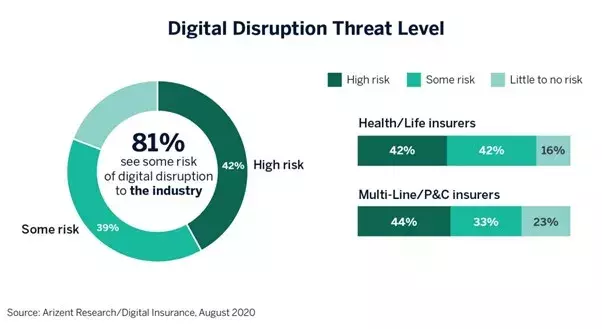
The Digital Insurance survey revealed that the real challenge insurers and other industries face is building an omnidirectional, all-encompassing view of their customers, the prerequisite to increasing customer satisfaction, retention, and share-of-wallet. In most cases, the data they need exists and is already somewhere in-house; the problem is that it is sitting in disassociated siloed applications scattered across the org chart.
If a company could combine all of its customer records and make their data interoperable across these and other lines, it could gain powerful insights in each customer’s behaviors and future needs… and build automated, hyper-personalized strategies for increasing lifetime share-of-wallet for each. That is the key takeaway of the recorded webinar on the present and future of insurance.
Read the full post: Digital Transformation and the Future of Insurance
Care By Volvo Approves Applications in Seconds
Nikhil Behl wrote: Volvo Cars has used the cloud-hosted FICO® Platform to digitize and accelerate the customer onboarding process for its new vehicle subscription service, Care by Volvo. By automating the process, Volvo has cut the credit check process on applicants from three days down to seconds.
Care by Volvo is a vehicle subscription service (Mobility-as-a-Service) designed to let customers enjoy the benefits of a new Volvo, without the challenges of owning one. For a fixed monthly fee, Volvo provides subscribers with a brand-new Volvo and covers all regular service, maintenance costs and breakdown cover. The service was introduced to reflect the shift in consumer preference toward car usage and away from absolute ownership.
“When we piloted Care by Volvo in Germany, we used manual credit reference checks, but this took too long and wouldn’t scale as we rolled the program out across Europe and North America,” said Fredrik Nero, product owner at Volvo Cars. “We needed to process applications faster, and approve applications in real time, in line with the Care by Volvo digital vision. Moving to FICO and its cloud-hosted digital decisioning solution gave us the speed and consistency we needed to improve the service and roll it out.”
Volvo adopted various components of the FICO Platform — FICO® Decision Modeler, FICO® Application Studio, FICO® Data Orchestrator Data Acquisition Module — in a cloud-hosted version for maximum efficiency. The solution connects to various external data providers, provides a workflow for managing referred decisions and is integrated with the digital sales channel. It is used for both consumer and business subscribers.
“We now have a single framework to handle third-party data consistently across countries,” said Nero. “This has allowed us to manage our credit policy with a single underwriting team, and yet allow for local market risk needs.”
Care by Volvo achieved its goal of real-time decisions for more than 80 percent of applications, with straight-through processing. As a bonus, the FICO-powered solution is being extended beyond Care by Volvo to all digital sales and new battery electric vehicles as the Volvo Digital journey progresses.
Read the full post: Care By Volvo Approves Applications in Seconds
It’s 2021. Do You Know What Your AI Is Doing?
Scott Zoldi wrote: Responsible AI has been one of my big topics for a few years now, the subject of many articles, blogs and talks I’ve given to audiences around the world. So how are companies faring in adopting Responsible AI, making sure they are using artificial intelligence ethically, transparently, securely and in their customers’ best interests?
The short answer: not great. A new report released today by FICO and market intelligence firm Corinium, entitled The State of Responsible AI, finds that most companies are deploying AI at significant risk. Here are a few topline findings that illustrate why:
- 65% of respondents’ companies can’t explain how specific AI model decisions or predictions are made
- 73% have struggled to get executive support for prioritizing AI ethics and Responsible AI practices
- Only one-fifth (20%) actively monitor their models in production for fairness and ethics
The report, the second annual executive research effort by FICO and Corinium focused on Chief Analytics, Chief AI and Chief Data Officers, examines how global organizations are applying artificial intelligence technology to business challenges, and how responsibly they are doing so. In addition to a troubling widespread inability to explain how AI model decisions or predictions are made, the study found that 39% of board members and 33% of executive teams have an incomplete understanding of AI ethics.
Who’s Responsible for Responsible AI?
Despite the embrace of AI, what is driving the lack of awareness of its responsible use? The study showed that there is no consensus among executives about what a company’s responsibilities should be when it comes to AI. As an example, almost half (43%) of respondents say they have no responsibilities beyond regulatory compliance to ethically manage AI systems that make decisions which may indirectly affect people's livelihoods. In my view, this speaks to the need for more regulation, if the designers of AI largely don’t see their responsibility as being more than what existing regulation enforces—or, in most cases, don’t enforce.
To drive the responsible use of AI in their organizations, senior leadership and boards must understand and enforce auditable, immutable AI model governance. They need to establish governance frameworks to monitor AI models to ensure the decisions they produce are accountable, fair, transparent, and responsible. Executive teams and Boards of Directors cannot succeed with a ‘do no evil’ mantra without a model governance enforcement guidebook and corporate processes to monitor AI in production. In their capacity, AI leaders need to establish standards for their firms where none exist today, and promote active monitoring. Only 20% of respondents actively monitor AI in production today.
Read the full post: It’s 2021. Do You Know What Your AI Is Doing?
Model Governance: Yapi Kredi Takes Advanced Approach
As regulators apply greater pressure on lenders to explain every decision, even those made using AI and machine learning, banking leaders worldwide are seeking a more advanced approach to model governance. An excellent example is Yapi Kredi, one of the largest private banks in Turkey, which will use FICO® Decision Central™ to manage analytics models and decision logic across the enterprise.
This is part of Yapi Kredi’s System of Intelligence vision and roadmap to seamlessly conduct and orchestrate smarter analytics and data pipelines and enhance AI / machine learning lifecycle management. FICO Decision Central enables businesses to capture models and other decision assets so that they can be reused, modified and improved over time.
“We position FICO Decision Central as the management layer of our System of Intelligence initiative, which aims to improve the accuracy of each and every decision we take across the bank,” said Hakan Yilmaz, Yapi Kredi’s Chief Data Officer. “With Decision Central, we will not only have full control and visibility over our complete set of analytical assets, but we can also make full and efficient use of our assets through a best-of-breed governance practice over the entire model development lifecycle.”
“Businesses increasingly invest in analytics to make better decisions, but managing those analytics, and the decisions, is critical to making this investment pay off,” said Emre Unlusoy, who manages FICO’s operations in Turkey. “Yapi Kredi understands the value of monitoring and managing every component that goes into making a decision. This investment will contribute not only to the quality of the bank’s decisions, but also to its ability to demonstrate regulatory compliance of every decision and every model.”
Read the full post: Model Governance: Yapi Kredi Takes Advanced Approach
The Nerd Oscars: 24 Best Data Science Moments in Movies
Jim Neumann wrote: With the Oscars approaching on April 25, a group of FICO employees were waiting for a Zoom meeting to begin, and talking about 2020 Oscar nominees; of course, the conversation soon shifted to stories about their favorite movies with nerdy, geeky, and propeller-headish themes.
The "Nerd Oscars" were born. A brief description of each winning film is below, along with publicly-available YouTube video clips of pivotal scenes where analytics, optimization, and raw mathematics give star performances.
So without further ado, the winners are...
1. Best Depiction of Iterative Simulation in a Time Loop: Groundhog Day
(Columbia Pictures)

Plot Summary: Phil Conner is a Pittsburgh TV weatherman on a remote assignment covering the annual Groundhog Day event Punxsutawney, Pennsylvania. Unfortunately, he gets ensnared in a time loop: every morning at 6:00, he is awoken by the same song on his clock radio, repeats the same interactions with the same people, and relives the same recurring events every day. Determined to break the spell, Phil starts making small changes to his daily routine, and learns that each change produces a different outcome… some positive, but mostly hilariously negative, making Groundhog Day a rom-com classic.
Each day, learning from the lessons of previous days, Phil slowly and iteratively learns which behaviors results in disaster, and which produces the most favorable outcomes. Eventually, he makes it through an entire “optimal” day with no missteps: the time loop is broken, and he returns to the present with his new love interest
Pivotal clips:
The first day: feels like déjà vu
The same day... over and over again
Why we like it: We really enjoy when things go well – or go optimally – for our customers. FICO’s optimization and Centralized Decisioning solutions make simulation, optimization, and analytics easy, even for non-technical users like Phil. By incrementally improving the accuracy and ROI of strategies with each pass, you’re on your way to smarter, faster, more profitable decisions. And break the spells that are holding your big data projects back. To get started, check out our new "Optimizing Success" program.
To see the other 11 Nerd Oscar winners, read the full post: The Nerd Oscars: 24 Best Data Science Moments in Movies

Popular Posts

Average U.S. FICO® Score at 716, Indicating Improvement in Consumer Credit Behaviors Despite Pandemic
The FICO Score is a broad-based, independent standard measure of credit risk
Read more
The GSE Data Is Public. Here's What It Shows About Credit Score Modernization.
Independent Milliman analysis of GSE historical data confirms what anyone can now verify directly: FICO® Score 10T is the most predictive score.
Read more
FICO® Score High Achievers: Is Age the Only Factor?
<p>FICO’s latest research on <a href="http://www.fico.com/en/blogs/risk-compliance/us-credit-quality-rising-the-beat-goes-on/" target="_blank">national FICO® Score distribution</a> shows that US credit quality continues to trend upwards, with an increasing number of consumers scoring in the highest scores ranges. Given that, we decided it was time to refresh our study on “<a href="http://www.fico.com/en/blogs/risk-compliance/infographic-what-does-a-high-credit-scorer-look-like/" target="_blank">FICO® Score high achievers</a>,” where we examine the credit behavioural profiles of consumers with higher credit scores.</p> <p>As expected, our latest study showed that older people generally have higher scores, as has been the case in our <a href="http://www.fico.com/en/blogs/risk-compliance/age-before-beauty-credit-worthiness-before-youth/" target="_blank">past research</a>. This is largely because they have trade lines that have been open longer, which leads to higher scores (assuming the trade lines are in good standing and all other things equal). The most credit savvy among you will remember that length of credit history accounts for roughly 15% of the overall <a href="http://www.myfico.com/CreditEducation/WhatsInYourScore.aspx" target="_blank">FICO® Score calculation</a>.</p> <p>But for younger consumers, it isn’t too helpful to say, “just wait until you are 50 years old, and that will fix things!” Thus, I decided to dive deeper with our analysis, including looking at the credit behavioural characteristics of younger consumers with high FICO® Scores.</p> <p>In this analysis, I looked at credit characteristics for the two highest score bands, 750-799 and 800-850, which have about 16% and 23% of the population, respectively. I further broke this down by looking at the characteristics of the youngest 15% in each group, which occurs at age 29 for the 750-799 group and 43 for the 800-850. We used FICO<strong>®</strong> Score 9 for our analysis, and examined typical variables of the categories that go into the make-up of the score.</p> <p><a href="http://www.fico.com/en/blogs/wp-content/uploads/2016/10/FICO-Score-High-Achiever-table.png"><img class="alignnone size-full wp-image-29367" src="http://www.fico.com/en/blogs/wp-content/uploads/2016/10/FICO-Score-High-Achiever-table.png" alt="fico-score-high-achiever-table" width="715" height="747" /></a></p> <p>Since there’s a lot to dissect in this chart, I’ll highlight a few findings that struck me: <ul> <li><strong>Credit history.</strong> Higher scores are undoubtedly associated with a longer time on file. What’s striking is the higher average time on file for the 800+ group, both overall and for revolving accounts (the most common trade line). Clearly, it helps to start credit use early in life – but that’s not the sole determining factor for high scoring. The younger cohorts in both the 800+ and 750-799 groups have time on file medians significantly less than their older counterparts.</li> <li><strong>New credit.</strong> High credit scorers do, in fact, pursue new credit. We see little variation in months since last trade line opening and last inquiry among all groups observed.</li> <li><strong>Pay on time.</strong> As you might expect, the further in the past the delinquency, the higher the score – and that’s <u>if</u> a delinquency ever happened. 95% of the 800+ people and 72% of the 750-799 group have never been delinquent, which is a striking contrast to the 57% for the total population. The percentages for the younger groups are even higher, especially so for the 750-799ers. Collection items are also scarce for these high scorers. While 23% of the national population have collection items greater than $99, the figures are only 0.5% for the 800+ group and 3% for the 750-799 group. It is clear that, in conjunction with starting a credit file early, paying on time is a key trait of the FICO® Score high achiever.</li> <li><strong>Balance and utilization.</strong> Finally, we look at how credit is being used, focusing on revolving product use. (Since most people only have one mortgage or one auto loan, variation in instalment product figures is minimal and driven by payment history, which is near perfect for high scorers, as we’ve seen.) FICO® Score high achievers tend to have more open revolving accounts. While the % active trades and utilization are generally lower, by no means do high scorers avoid the use of credit products. What drives the difference here is the amount of <u>available</u> revolving credit utilized. The 800+ group is roughly 1/4 of the national median, both in total and on their highest utilized card; they also have lower balances and more cards<em>. </em>The 750-799 group is more active and higher utilized, but still only at 2/3 of the national figures. The young 750-799 group compensate with lower revolving balances and, as a result, lower utilization, which is in line with what we see for the 800+ group.</li> <li><strong>Benchmarks.</strong> I’d like to point out that while this study provides good benchmarks of the typical credit traits of the FICO® Score high achiever, individual credit profiles will vary widely. And keep in mind that when we sort groups of consumers as a whole by different behaviours, some results may look superficially odd. For example, the 800+ band has a longer median average open account time (128 months) than average revolving months on file (140 months).</li> </ul> So, what do we conclude? A huge takeaway is that high scorers don’t have too much in the way of serious delinquencies and negative public record data.</p> <p>In most respects, the young 800+ people are like their peer group. They really only differ markedly in their shorter credit history and higher non-mortgage balance, both of which are a function of life stage. Our results show that you don’t have to be a credit product hermit; these high scorers have more credit cards. The takeaway is to start credit activity early and maintain well-managed and moderate usage.</p> <p>In many ways, the young 750-799 people are more interesting because their age profile is much younger. Their credit characteristics differ more from their peer group, particularly in terms of length of credit history. They compensate by having almost pristine credit records and lower balances.</p> <p>Ultimately, 39% of US consumers are FICO® Score high achievers, which they accomplish by following common-sense credit practices. It ain’t rocket science!</p>
Read moreTake the next step
Connect with FICO for answers to all your product and solution questions. Interested in becoming a business partner? Contact us to learn more. We look forward to hearing from you.